Nilotica Shea Butter Wholesale from Uganda: A Sourcing Guide for Brands and Importers
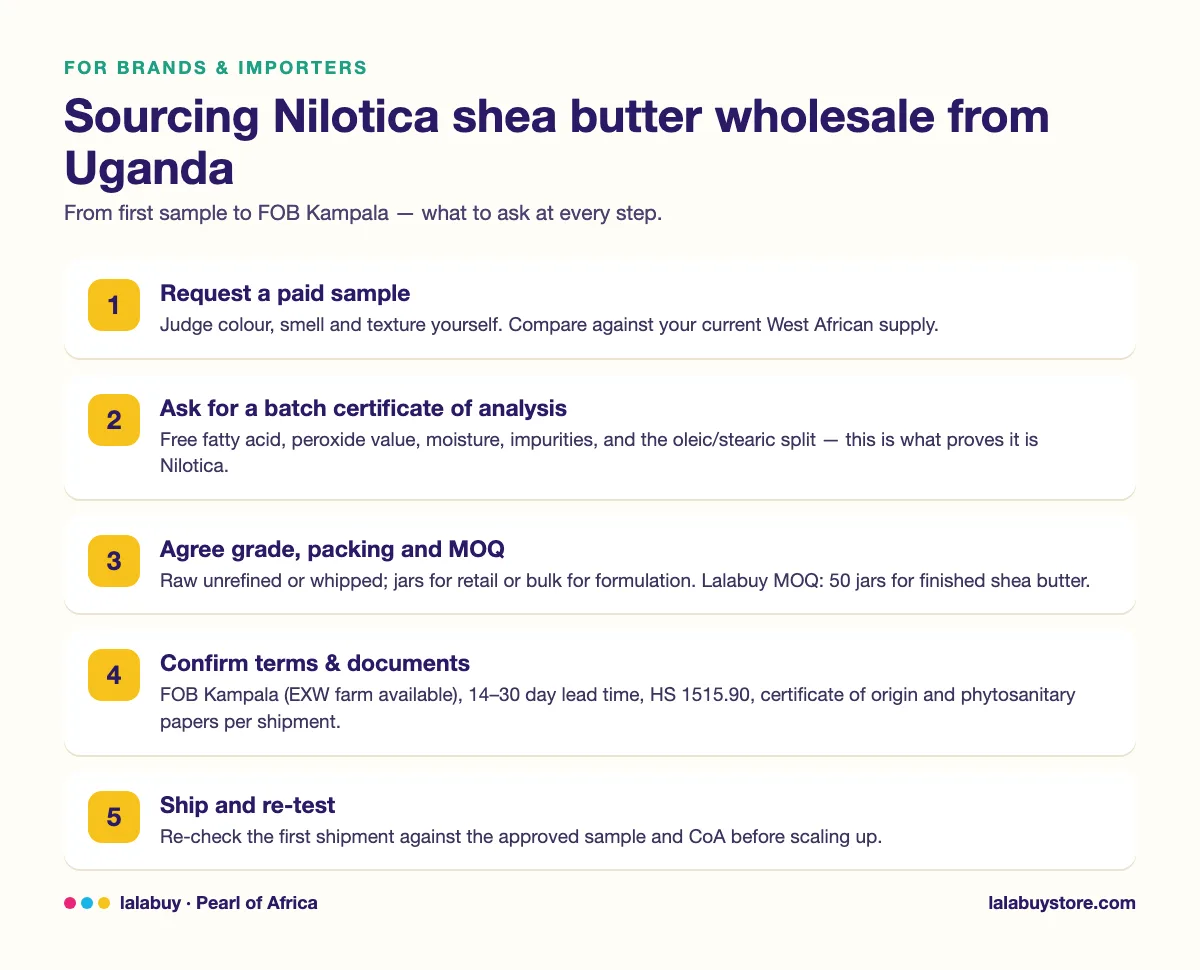
If you make body butters, lotions, hair care or baby care, the shea you choose shows up directly in how your product feels. More formulators are now switching part or all of their supply from West African shea to East African Nilotica shea butter for its softer texture and lighter skin feel. This guide explains how to source it from Uganda without surprises.
Why brands are choosing Nilotica
Nilotica shea is richer in oleic acid and lower in stearic acid than West African shea, which makes it softer, easier to spread and quicker to absorb (full comparison). In formulation that means smoother whipped butters, creams that don't feel waxy, and less need for added liquid oils.
Market research backs this up. A GIZ international market study found Ugandan shea has the strongest potential in cosmetics, particularly the natural-cosmetics segment in Europe and China. The same study notes the main barrier: many manufacturers can't yet tell Nilotica from West African shea, so suppliers who can prove what they sell stand out. The EU's CBI programme also tracks growing European interest in Nilotica.
Nilotica is a cosmetic ingredient first. Chocolate makers, who need a hard fat, generally prefer West African shea.
Step 1: Start with a paid sample
Never buy bulk shea unseen. Order a sample and compare it side by side with your current supply: colour, scent, texture at room temperature, and how it behaves in your recipe. Lalabuy ships paid samples by courier and quotes them separately from bulk pricing.
Step 2: Ask for a certificate of analysis
A batch certificate of analysis (CoA) is what turns "Nilotica" from a marketing word into a fact. Ask for:
- Fatty acid profile — the oleic/stearic split is your proof of Nilotica.
- Free fatty acid (FFA) — lower is fresher; high FFA means older nuts or poor processing.
- Peroxide value — a measure of oxidation and rancidity.
- Moisture and impurities.
Specify acceptable limits in your purchase order, and keep the sample and CoA as your reference for every later shipment.
Step 3: Agree grade, format and MOQ
- Grade: raw unrefined for natural-cosmetics brands; refined only if you need a neutral, odourless base.
- Format: finished retail jars (ready to sell or private-label) or bulk for your own formulation.
- MOQ: at Lalabuy, the minimum for finished Nilotica shea butter is 50 jars, and mixed orders with our other Ugandan lines are welcome once each line meets its minimum. See the wholesale page for current terms.
Step 4: Confirm trade terms and documents
- Incoterms: we quote FOB Kampala, and EXW from the farm is available for shea butter.
- Lead time: 14–30 days after the purchase order, depending on volume.
- HS code: 1515.90 (other fixed vegetable fats).
- Documents per shipment: commercial invoice, packing list, certificate of origin and phytosanitary certificate. Confirm early with your customs broker which documents your country requires.
Step 5: Re-test the first shipment
When your first order lands, compare it with the approved sample and CoA before you scale up. Consistent suppliers will welcome this.
Get a quote
Tell us the volume, format (jars or bulk), destination port and target timeline through the wholesale RFQ form or on WhatsApp +256 700 807 217. For the story behind our shea, read Pearl Nilotica Whipped Shea Butter: Uganda's finest skin food.
Frequently asked questions
Is Nilotica shea butter more expensive than West African shea? Yes. It grows in a smaller region and much of it is hand-processed, so supply is limited. Most brands find the texture difference worth the premium for leave-on products.
Can I private-label your shea butter? Ask us through the RFQ form with your volume and packaging needs.
Does Nilotica have a different INCI name? No. Both subspecies are listed as Butyrospermum parkii butter, which is why the CoA and origin documents matter.