Nilotica vs Ghana Shea Butter: Which Is the Best Shea Butter for Your Skin?
Search "best shea butter" and you will find hundreds of tubs that all say the same thing: raw, pure, African. What most labels don't tell you is that there are two different kinds of shea butter, made from two different subspecies of the same tree — and they behave very differently on your skin.
This guide compares East African Nilotica shea butter (from northern Uganda and South Sudan) with West African shea butter (from Ghana, Burkina Faso, Nigeria and Mali), so you can choose the right one for what you actually want to use it for.
Two trees, one name
All shea butter comes from the nuts of the shea tree, Vitellaria paradoxa. Botanists split it into two subspecies:
- subsp. paradoxa — grows across the West African savanna belt, from Senegal to Nigeria. Ghana is one of the best-known producers, and most of the shea butter sold worldwide is this type.
- subsp. nilotica — grows in East and Central Africa along the Nile basin, especially northern Uganda and South Sudan. It is far less common, which is why most shoppers have never knowingly tried it.
On an ingredient list both are written the same way (Butyrospermum parkii butter), so the only way to know which you are buying is the origin on the label.
The real difference: oleic vs stearic acid
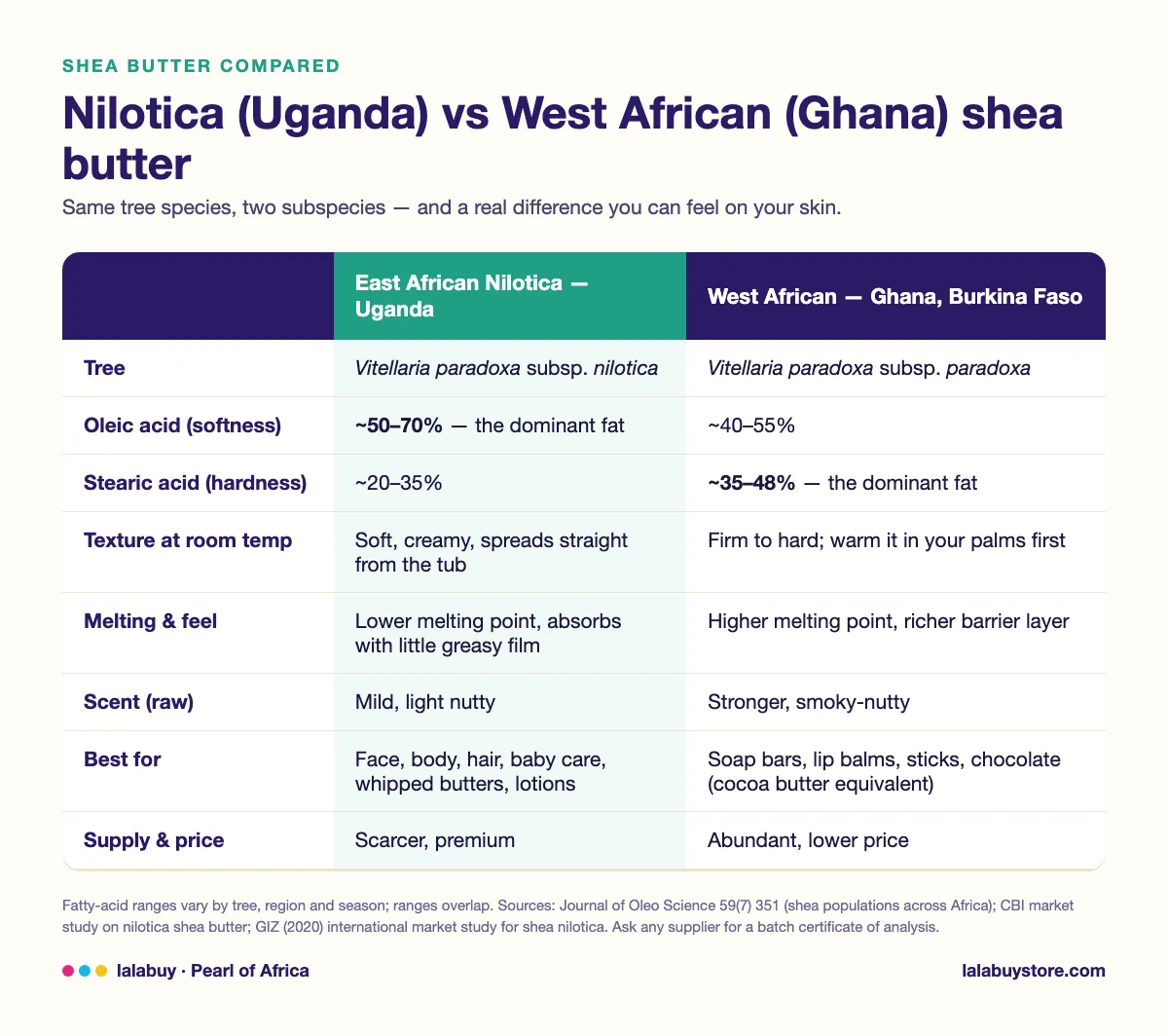
Shea butter is mostly two fats. Oleic acid is a liquid fat (the same one that makes olive oil liquid). Stearic acid is a solid fat that makes butter hard. The balance between them decides how the butter feels.
Studies of shea from across Africa found that Ugandan shea is dominated by oleic acid, while West African shea is dominated by stearic acid (CIFOR-ICRAF; Journal of Oleo Science). Trade data from the EU's import-promotion agency puts Nilotica at roughly 57–65% oleic and 30–32% stearic acid (CBI). Figures vary from tree to tree and season to season, and the ranges overlap — but the direction is consistent.
What that means in your hands:
- Nilotica is soft and creamy at room temperature. You can scoop it with a finger and it spreads straight away, with no need to warm it.
- West African shea is firm. You usually need to rub it between your palms before it will spread.
- Nilotica melts at a lower temperature, so it sinks into skin faster and leaves less of a greasy film.
- Raw Nilotica smells milder — lightly nutty rather than the stronger, smoky scent many people notice in West African butter.
Which is the best shea butter for skin and hair?
For anything you leave on your skin or hair, Nilotica is the better choice. Its softness makes it easier to apply to the face, to a baby's skin, or through braids and 4C hair, and its lighter feel suits daily use in a warm climate like Uganda's.
West African shea has its own strengths. Because it is harder, soap makers and lip-balm makers often prefer it — it helps bars and sticks hold their shape — and chocolate makers buy it as a cocoa butter substitute. It is also much more plentiful, so it is cheaper.
So the honest answer is:
- Face, body, hair, baby care, whipped body butter, lotions: choose Nilotica.
- Soap bars, lip balm sticks, hard balms on a tight budget: West African shea works well.
Why Nilotica costs more
Nilotica trees grow in a smaller area, and much of the harvest is still hand-collected and processed by women's groups in northern Uganda. Less supply and more handwork mean a higher price. Many international formulators are only now learning to tell the two apart — a GIZ market study found that many European and Chinese manufacturers did not know the difference, which is exactly why Nilotica has been under-priced and under-valued.
How to know you are getting real Nilotica
1. The label names Uganda or South Sudan, ideally the region (for example the Nile basin or northern Uganda). 2. It is soft at room temperature — if it is rock-hard in Kampala heat, it is probably not Nilotica. 3. The scent is mild and nutty, not sour. 4. It contains one ingredient only.
For a full checklist, see our guide on how to choose the best raw, unrefined shea butter.
Where to buy Nilotica shea butter in Uganda
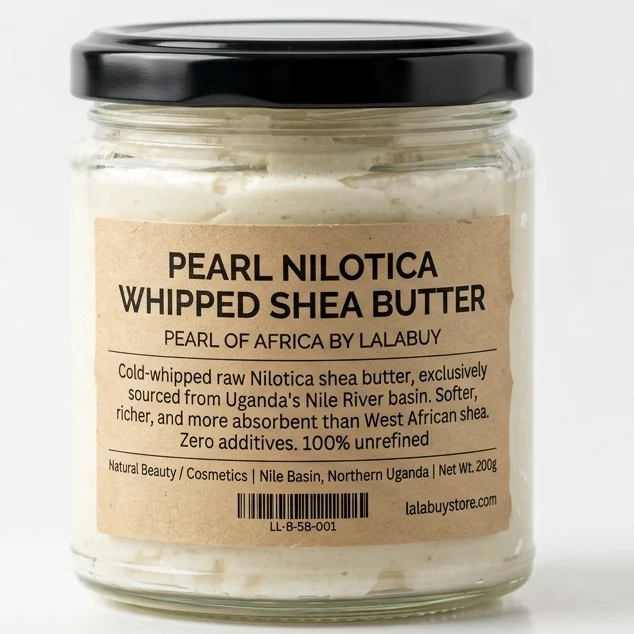
Pearl Nilotica Whipped Shea Butter is raw Nilotica shea butter from northern Uganda's Nile basin, whipped for an even softer texture and nothing added. Order it on lalabuystore.com or on WhatsApp +256 700 807 217 — same-day delivery in Kampala when you order before 2 PM, and 1–3 days to the rest of Uganda.
Buying for a brand or shop? See wholesale Nilotica shea butter from Uganda.
Frequently asked questions
Is Ghana shea butter bad? No. It is real, good-quality shea butter — it is simply harder and stronger-smelling, which suits some uses (soap, balms) better than others.
Is Ugandan shea butter the same as Nilotica? Shea butter from northern Uganda is Nilotica. Always check the origin on the label, because some sellers in Uganda also import West African shea.
Why is my Nilotica shea butter grainy? Small grains are fat crystals that form when shea melts and cools slowly. They melt on contact with skin and do not mean the butter has gone bad.